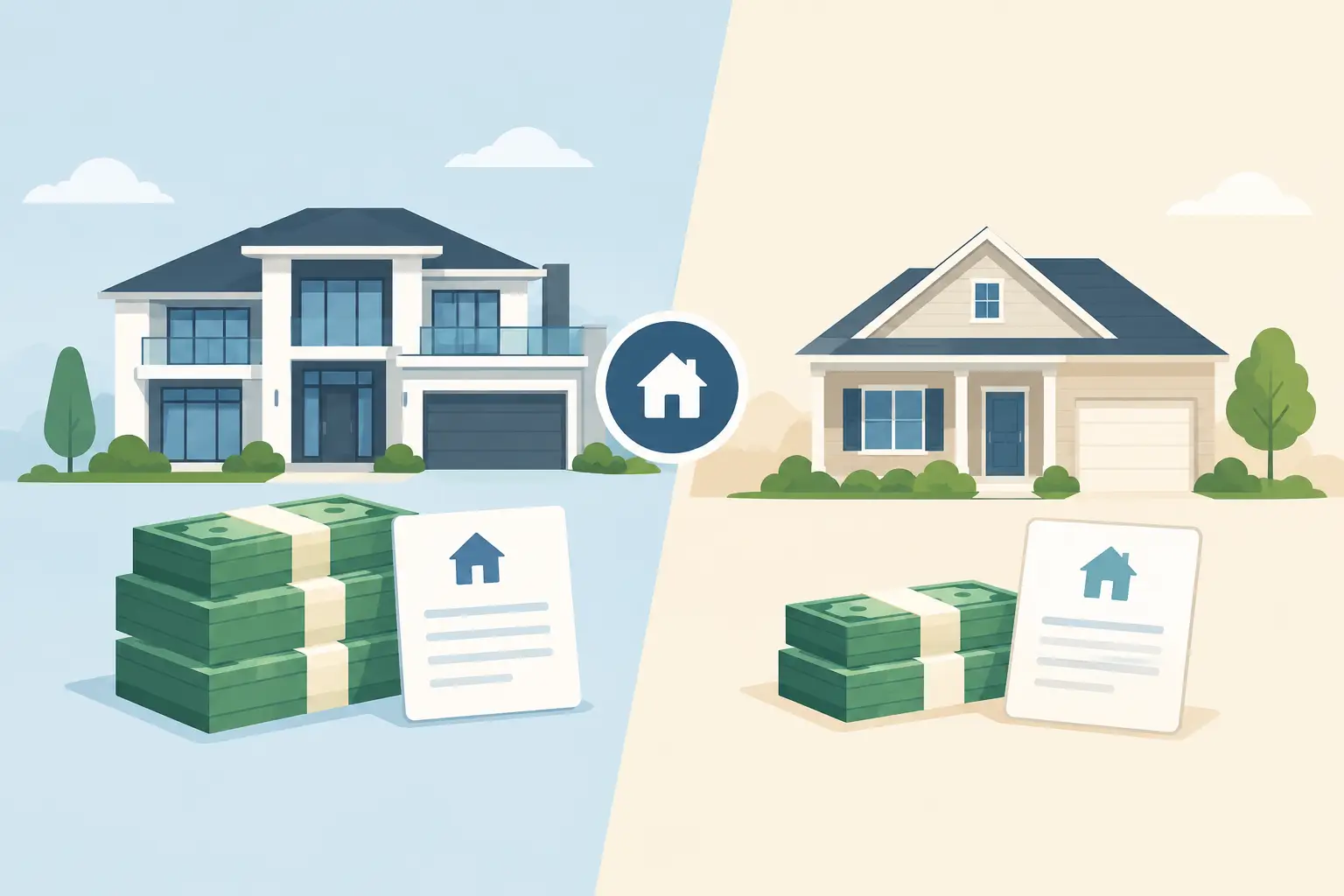
A home purchase can cross from familiar territory into a more specialized lending conversation faster than many buyers expect. The key question in a jumbo loan versus conventional loan comparison is not simply how much home you want to buy. It is whether the loan amount, your financial profile, and the property all fit the guidelines for the financing option that best supports your plans.
For buyers considering a move-up home, a luxury property, or a home in a higher-cost market, the distinction matters. A jumbo loan may provide the borrowing power you need. A conventional loan may offer a more flexible or straightforward path when the loan amount falls within applicable limits. The right answer comes from looking at the complete picture, not just one rate or one down payment number.
What separates a jumbo loan from a conventional loan?
A conventional mortgage is any home loan that is not backed by a government agency such as the FHA, VA, or USDA. Most buyers use the term to mean a conforming conventional loan, which meets the purchase and underwriting standards of Fannie Mae and Freddie Mac.
A jumbo loan is generally a conventional loan whose balance exceeds the conforming loan limit for the county where the property is located. Those limits are updated periodically and can be higher in designated high-cost areas. Because jumbo loans exceed the amount eligible for purchase by Fannie Mae or Freddie Mac, lenders set their own guidelines for underwriting, pricing, reserves, and acceptable property types.
That distinction has a practical effect. A conforming conventional loan follows a widely established framework. A jumbo mortgage is often more individualized, with lenders looking closely at the borrower’s overall financial strength.
It is also worth clearing up a common point of confusion: “conventional” does not always mean “conforming.” Jumbo financing is typically conventional financing too. In everyday conversations, though, buyers usually mean a conforming conventional loan when they compare a jumbo loan with a conventional loan.
Jumbo loan versus conventional loan: the differences that matter
The loan limit is the starting point, but it is far from the only consideration. Your down payment, credit history, income, assets, monthly debts, and goals for the property can all shape which option makes the most sense.
Loan amount and home price
A jumbo loan is designed for a loan balance above the conforming limit. That does not mean every higher-priced home requires jumbo financing. A larger down payment can bring the mortgage amount below the local limit, potentially allowing you to use conforming conventional financing.
For example, two buyers may purchase similarly priced homes. One buyer puts down enough to keep the loan within the county’s conforming limit. The other finances a larger portion of the purchase price and needs a jumbo loan. The purchase price alone does not determine the loan type.
In some situations, a buyer may also consider a first mortgage combined with a second mortgage to avoid a jumbo balance. That approach can work for certain financial profiles, but it introduces another payment, another interest rate, and another layer of qualification. It should be evaluated carefully rather than treated as an automatic strategy.
Credit, debt, and financial reserves
Conventional conforming loans can accommodate a range of qualified borrowers, including some buyers with modest down payments. Credit score and debt-to-income requirements vary by loan program, but the standards are generally structured and well understood.
Jumbo lenders commonly expect stronger credit, lower debt relative to income, and more cash reserves after closing. Reserves are funds you still have available after your down payment and closing costs are paid. Depending on the transaction, a lender may want to see enough liquid or eligible assets to cover several months of housing payments.
This does not mean a jumbo borrower must have a perfect financial profile. It does mean consistency matters. Stable income, a thoughtful debt picture, documented assets, and a strong repayment history can all help support a jumbo application.
Self-employed buyers, commission-based earners, and investors may still qualify for jumbo financing. They should simply expect a more detailed review of tax returns, business income, assets, and any properties they already own. Preparing documentation early can prevent delays once the right home is under contract.
Down payment and mortgage insurance
Many buyers assume a jumbo loan always requires 20% down. That is not universally true. Some jumbo programs allow lower down payments for highly qualified borrowers, although the available options and pricing can differ substantially by lender, credit profile, and loan amount.
Conforming conventional loans may permit down payments as low as 3% for eligible buyers. When the down payment is below 20%, private mortgage insurance, often called PMI, is commonly required. PMI can increase the monthly payment, but it may allow a buyer to purchase sooner instead of waiting years to save a larger down payment.
Jumbo loans handle mortgage insurance differently. Some programs do not use traditional PMI, while others may require a larger down payment or price the loan differently to account for additional risk. The useful comparison is not just the down payment percentage. Compare the full monthly payment, cash needed at closing, reserve requirements, and long-term financial comfort.
Interest rates and costs
There is no universal rule that jumbo rates are always higher than conventional rates. At times, jumbo loan rates can be competitive with, or even lower than, conforming conventional rates for borrowers with excellent credit and significant assets. At other times, they may be higher.
Rates move with the market, and individual pricing depends on much more than loan type. Credit score, loan-to-value ratio, occupancy, property type, debt-to-income ratio, points, and cash reserves may all affect the offer you receive. Closing costs can also differ, particularly if an appraisal for a high-value or unique property requires additional work.
That is why an online rate alone is not enough to make a decision. A meaningful comparison uses the same purchase price, down payment, loan term, and estimated closing date. It should also account for taxes, homeowners insurance, HOA dues where applicable, and the amount of cash you want to preserve after closing.
Property and appraisal considerations
A higher-value property can require a more complex appraisal. If the home is distinctive, located in a rural area, or has few comparable recent sales, the appraisal process may take longer and involve added review. This can happen with any mortgage, but it is especially relevant for jumbo financing because the property value supports a larger loan balance.
Buyers should avoid assuming that a strong offer automatically makes appraisal concerns disappear. A lender still needs to confirm that the property meets eligibility standards and that the value is supported. Leaving adequate time for financing and appraisal in the purchase contract can be a wise decision.
Which loan is right for your situation?
A conforming conventional loan may be a strong fit if your required loan amount falls within the local limit and you want broad program availability, potentially lower cash reserve requirements, or a low-down-payment option. It can be especially practical for buyers who have solid income and credit but prefer to keep more funds available for renovations, moving expenses, or future goals.
A jumbo loan may be the better fit if you are purchasing a higher-priced home and need financing beyond the applicable conforming limit. It can also make sense when you have a strong credit profile, substantial assets, reliable income, and a desire to keep your financing in one primary mortgage rather than layering multiple loans.
Neither option is automatically better. A buyer with a large down payment might have the flexibility to choose either path. Another buyer may technically qualify for a jumbo loan but decide that a lower purchase price creates more room in the monthly budget. The best choice is the one that supports both your closing day and your life after closing.
Questions to ask before choosing a loan
Before you make an offer, ask what the current conforming loan limit is for the property’s county and whether your planned down payment keeps the mortgage below it. Then ask for side-by-side scenarios showing the monthly payment, cash to close, reserve expectations, estimated rate, and any mortgage insurance costs.
It also helps to discuss how long you expect to own the home. If you anticipate refinancing, relocating, or receiving a major change in income within a few years, that context can affect how you weigh rate, points, and upfront costs. If this is a long-term family home, predictability and payment comfort may deserve greater weight.
A home loan should fit more than a spreadsheet. A knowledgeable loan officer can help you compare the numbers, explain the trade-offs clearly, and make sure the financing choice reflects the home and future you are working toward.